
The Fashion Industry's $500 Billion Blind Spot (and What We Can Do About It)
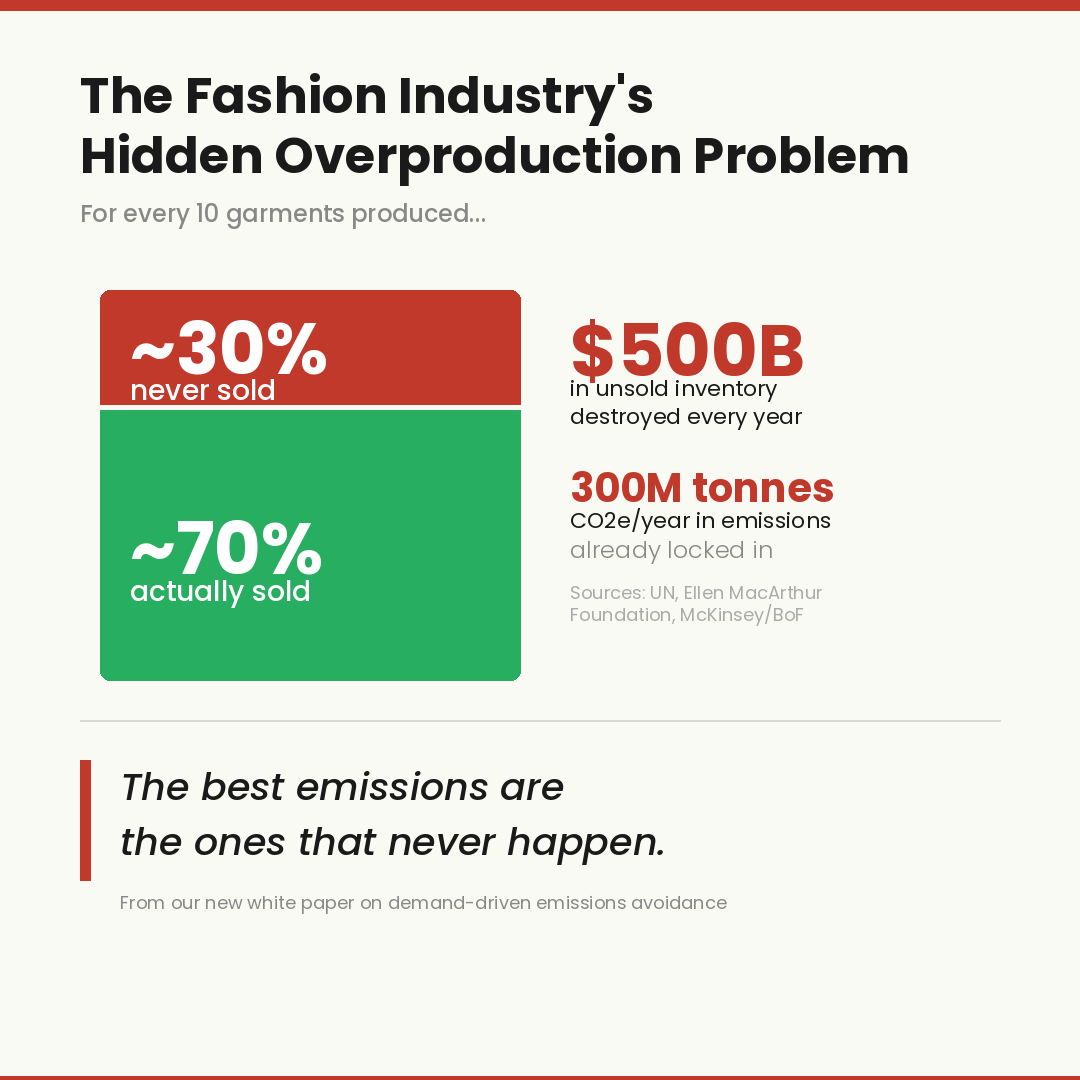
Every year, the fashion industry produces roughly 150 billion garments. About 30% of them are never sold. They get marked down, written off, incinerated, or shipped to landfills in places like the Atacama Desert in Chile and the coast of Accra, Ghana.
The dollar figure behind that waste is almost hard to process. The Ellen MacArthur Foundation and the United Nations estimate the value of disposed unsold inventory at $500 billion annually. McKinsey and the Business of Fashion pegged 2023 excess stock alone at $70 to $140 billion. LVMH and Kering recorded nearly €5 billion in impaired inventory in a single year.
This isn't a sustainability problem dressed up in business language. It is a business problem. Brands are spending enormous amounts of capital to manufacture, ship, warehouse, and eventually destroy products that no consumer ever wanted.
And the climate cost compounds it. Every one of those unwanted garments carried real emissions. The factories ran. The trucks shipped. The energy was consumed. By the time a product hits a landfill unsold, its carbon footprint is already fully locked in. We're talking roughly 300 million tonnes of CO2e per year from overproduction alone. That's about equal to the annual emissions of France.
The question nobody had formalized
I spent the past several months working as an advisor to Tatiana Alexa and the team at Sangrove on what feels like an obvious question: what if brands could verify what consumers actually want before deciding what to produce?
Not after production. Not at the markdown rack. Before the factory starts running.
The tools to do this now exist. Consumer demand can be validated through direct engagement before production decisions get locked in. When that happens, the waste simply doesn't occur. The garments that nobody wants are never made. The emissions from producing them never enter the atmosphere.
This is fundamentally different from the way most of the industry thinks about sustainability. The standard approach focuses on reducing the impact of production that's already happening. Better materials, cleaner factories, more efficient logistics. All important. But none of it addresses the root cause: making things that nobody wants in the first place.
Prevention at the decision point
We put the methodology behind this into a white paper: "The Sangrove Methodology for Calculating Consumer Demand-Driven Emissions Avoidance in Supply Chains." I co-authored it with Tatiana Alexa, Natalia Miinea, and Stan Mashov, with methodological review from Michelle O'Keeffe at the University of Edinburgh Business School.
The core framework quantifies the emissions that never happen when you prevent overproduction through verified demand signals. It anchors CO2e avoidance to pre-production decision points, the moment a brand commits to manufacturing a specific volume. If validated demand data changes that decision, and fewer units are produced as a result, the avoided emissions can be calculated and attributed.
A few things that were important to us in building this:
It had to be conservative. The methodology builds in baseline constraints and avoids inflated counterfactuals. It draws on established principles from carbon markets and environmental accounting to ensure credibility.
It had to complement what already exists. This isn't a replacement for Scope 1, 2, or 3 inventory accounting. It's a new lens. Existing frameworks measure emissions from what you do produce. This measures the emissions from what you choose not to produce.
It had to be actionable. The white paper isn't theoretical. It's designed to support real pilot programs with brands that want to integrate demand verification into their production planning.
The potential scale is significant. If widely adopted across the fashion and apparel industry, this approach could prevent roughly 300 million tonnes of CO2e annually, equivalent to taking 65 million cars off the road.
The best emissions are the ones that never happen.
That line from the white paper captures it. We spend enormous energy and capital trying to reduce, offset, and account for emissions after they occur. What if we redirected some of that effort toward making sure they never occur in the first place?
For brands, this is also a profitability story. Every unsold garment represents wasted raw materials, wasted labor, wasted shipping, wasted warehousing, and wasted capital. Reducing overproduction doesn't just lower emissions. It improves margins, frees up working capital, and reduces the reputational risk that comes with destroying product.
The EU is already moving in this direction. Under the Ecodesign for Sustainable Products Regulation, fashion companies operating in the EU are now required to report on unsold textiles, and destroying unsold products is becoming illegal in 2026. Brands that get ahead of this will have a real competitive advantage.
Read the white paper
If you work in sustainability, retail, fashion, or climate finance, the full methodology is available for download at sangrove.com/methodology. It's a detailed read, but worth the time if you're thinking seriously about where the next wave of emissions reduction will come from.
Working with companies like Sangrove is what I do
My work with Sangrove is one example of how I partner with values-aligned companies to sharpen their strategy, develop new frameworks, and bring rigorous thinking to problems that matter. Through my advisory practice, I work with founders and leadership teams at the intersection of climate, technology, and impact, helping them move from vision to execution.
If you're building something that aligns profit with purpose and could use a strategic thought partner with 30 years of experience in this space, I'd welcome the conversation. You can reach me through the contact page
