
Can Curiosity Be an Economic Development Strategy?
When people get hooked on identifying the animals and plants alive around them, the people, their local economies, and the planet all come out ahead.
Photo credit: Josh Knauer
Luz Dary Echavarría spent more than a decade clearing her mountainside in northern Colombia, cutting trees into sacks of charcoal and then running milk cows over the bare slopes. In a recent New York Times story, she describes the turn her life took. She now hosts birders who climb four hours of rutted road north of Medellín to find the golden-headed quetzal. She stands on that same slope and whistles its call until one swoops in. "My little fledgling! My love!" she calls. The birds, she says, have given her "a quality of life I could never have imagined."
What made it happen is almost boring: two free apps from Cornell's ornithology lab, Merlin and eBird. Merlin listens to a bird call and tells you, with high but imperfect accuracy, what you're probably hearing. eBird logs sightings and has quietly become the largest bird-observation database in the world. But the technology isn't the interesting part. What's interesting is what it did. It put Echavarría's farm, and the Giraldo family's small lodge, onto a map that people elsewhere actually use to decide where to go. One birder emailed the Giraldos from India last Christmas to say he was preparing to make the journey. The apps are how he found them.
Look at who that one shift pays out to.
People: a former charcoal-maker with no formal training and no language but Spanish now reads her own forest, makes convincing bird calls, and lives better doing it.
Local economies: "avitourism" brings real income to places that used to be just dots on a back road. The Giraldos call the influx "life-changing," and the visitors keep coming, lately many of them from China.
The planet: this is the oldest insight in ecotourism, and it still holds. When a living bird is worth more than the acre you'd clear to graze a cow, protecting the habitat becomes the rational choice, not the charitable one. Colombia is only the 25th-largest country by land area, yet it wins the world's birding counts every single year, because that diversity is still standing.
That whole chain, person to place to protection, starts with a simple first step: somebody being able to find out what's alive and present around them.
This is exactly why I created EarthAtlas.org
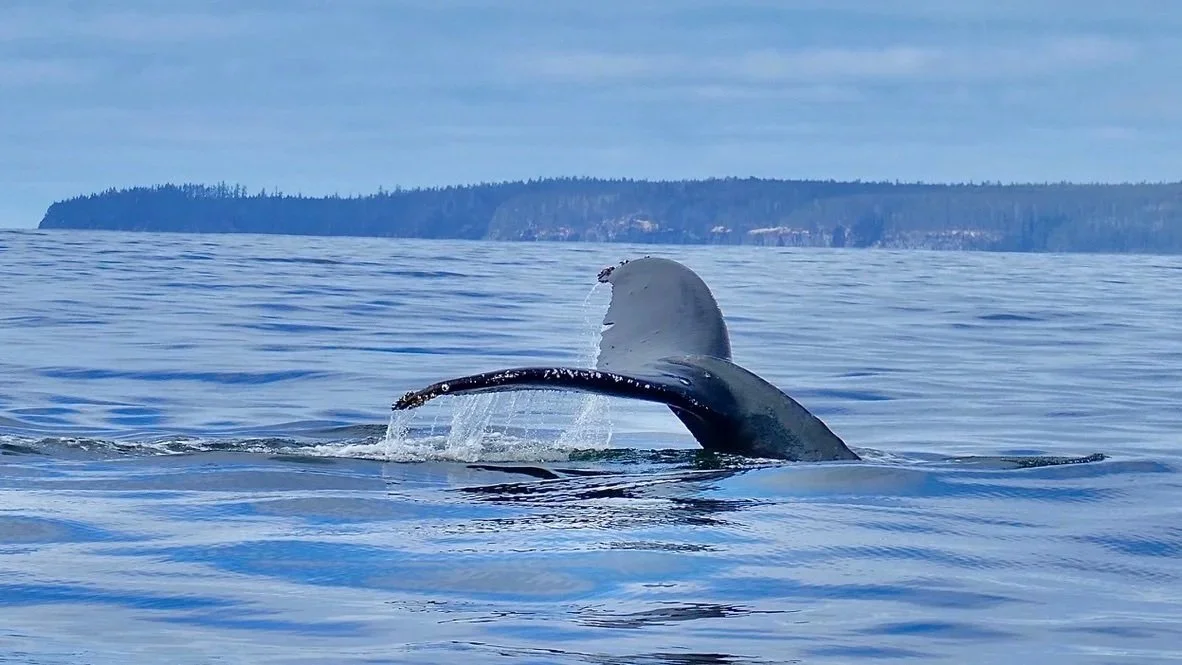
Photo credit: Josh Knauer
Last summer I was on a boat in the Puget Sound, scanning the water for fins and flukes, when a friend asked the obvious question: what whales are actually out here right now? It was 2025, and we had phones, signal, and an app for everything from identifying a bird by its song to booking a table across town. What we didn't have was a simple way to see, in one place, what was near us. iNaturalist has the data, but it's built for submitting observations, not for casually exploring them. GBIF holds an extraordinary global dataset, but it's designed for researchers. The regional wildlife networks each cover only their own patch. We spent most of the afternoon cobbling a rough picture together from five browser tabs while the whales went on doing whatever whales do.
That afternoon stuck with me, because of what it exposed. I've spent most of my career at the intersection of data and conservation, building platforms that gather environmental information and get it in front of people. But I'd always treated that data as something for institutions: scientists, NGOs, agencies, analysts writing reports I would never read. The boat reframed it. The same observations that answer "what is the decades-long trend in Southern Resident orca sightings" can also answer something far more human. Are there whales near me, right now? Could I go see one? The data had been there all along, collected over decades by scientists, naturalists, birders, fishing crews, and volunteers. The problem was never the data. The problem was that nobody had bothered to make it easy.
Screenshot of EarthAtlas.org
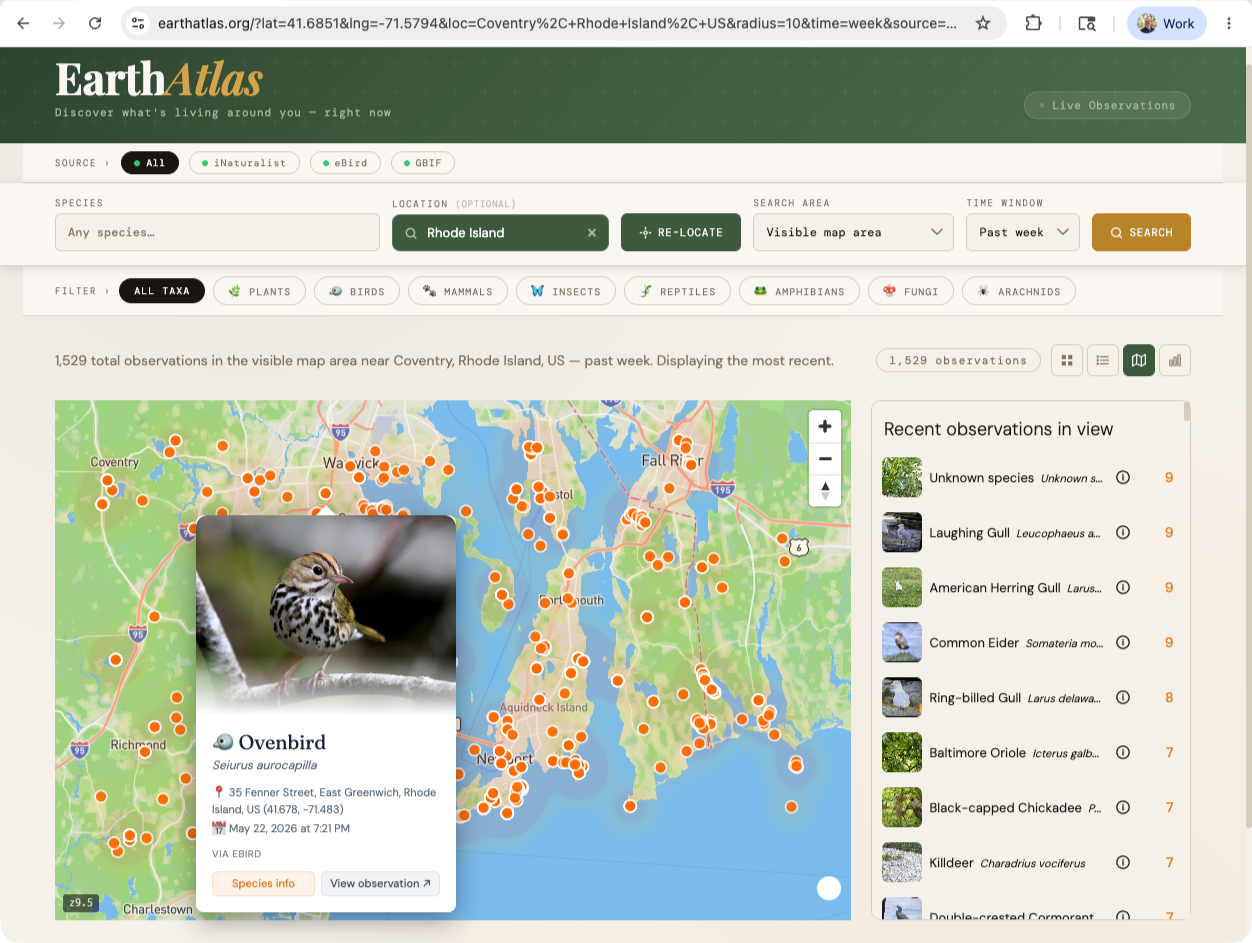
This wasn’t a new question for me. I'd been asking some version of it since I was a kid wandering the woods behind my house, turning over rocks just to see what lived underneath. I never stopped wanting to know what was out there. I'd just lost the easy way to find out. So I built the thing I wanted on that boat. EarthAtlas is, at its simplest, a map of where life on Earth has been seen. It pulls nearly four billion observations from iNaturalist, eBird, GBIF, and other open sources into one place, and it answers the two questions a normal person actually asks. What's living around me right now? And what will I see when I get to where I'm going? That second question, "I'm going to Santa Cruz in June, what whales am I likely to see?", is the same impulse that sent a birder from India to a small lodge in the Colombian Andes. Merlin and eBird did it for birds. EarthAtlas does it for everything that's ever been recorded alive, from sharks to fungi. The hard part was never the data. It was the translation: turning a dataset built for institutions into something my friends on that boat could have pulled up in thirty seconds.
The Times piece doesn't duck the pushback, and it deserves a real answer. A lot of serious naturalists distrust the wave of apps that will identify a species for you, and there are many of them now. The complaint is partly about gamification, birding reduced to collecting species like Pokémon cards, and partly about accuracy. Merlin is fallible, and as the renowned Colombian birder Luis Germán Olarte puts it, if you lean only on the app, "the app doesn't make you a birder." On that narrow point, he's right. But the deeper risk isn't the occasional bad ID. It's the instinct to decide that only the people who already know the birds are entitled to go looking for them. Remember what this actually is: citizen science. It runs on retirees, backpackers, farmers, and curious kids, not on credentials.
Rachel Carson made this case sixty years ago in The Sense of Wonder: the problem was never a shortage of facts; it was a shortage of wonder, and wonder doesn't require a credential. Cultivate curiosity first, she argued, and the knowledge and the caring tend to follow. Wall it off so that only the purists belong, and we repeat one of the oldest mistakes in conservation, treating the living world as the property of experts rather than the inheritance of everyone. So I come down on Rachel’s side.
The app isn't the destination. It's the on-ramp. The retiree, the backpacker, and the kid opening one of these apps for the first time aren't naturalists yet. They're just someone who learned that the noise outside the window has a name. That's where every naturalist started. Depth comes later: outside, with binoculars, patience, and a lot of getting it wrong. The app's only job is to get you to look up.
Connection is half of it. The other half is protection, and the article keeps circling the real threat without quite naming it. Echavarría's own decade with a chainsaw. eBird director Chris Wood's point is that the forests these migratory birds depend on are being cleared by corporations and small family farms alike. Goodwill alone doesn't stop that. You have to be able to see where the forest is actually being lost, and you have to give the people living on that land a reason and a way to keep it standing.
Screenshot of EarthAtlas Forest Monitor
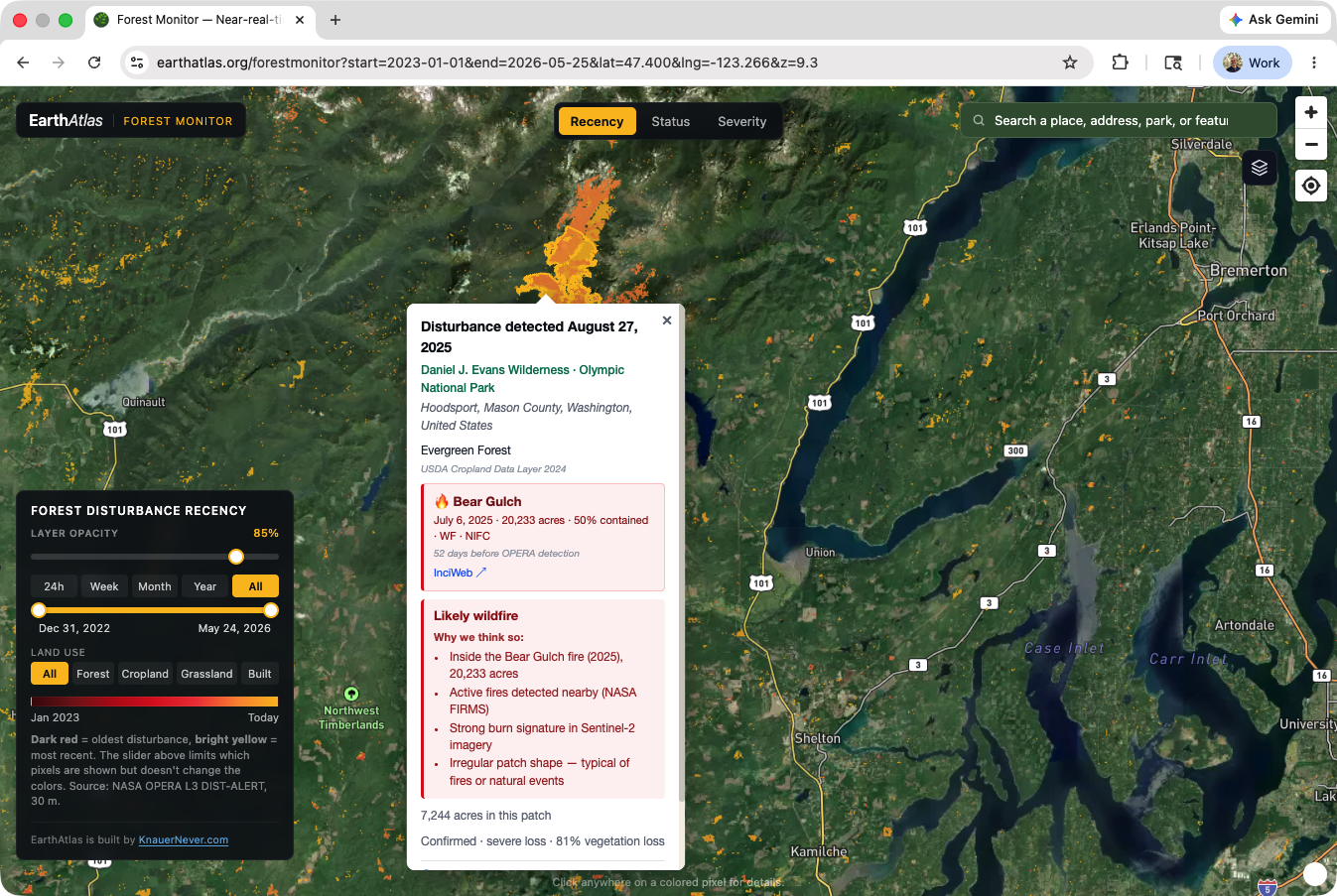
That's why EarthAtlas didn't stop at sightings. EarthAtlas Forest Monitor watches where forests are being cleared or burned anywhere on Earth using NASA satellite data, updated every 12 hours. It cross-checks crop maps, harvest calendars, and fire records to tell you whether a given change is a routine harvest/farming activity, a wildfire, or logging activity. Where I want to take it next is turning that into a tool that helps the Echavarrías of the world, the smallholder cacao and coffee farmers, generate the deforestation-free certifications they now need to sell their crops into Europe. Same logic as avitourism, a different instrument to make the standing forest worth more than the cleared one.
Echavarría told the reporter that now, whenever she hears an odd sound, she feels she has to record it and find out what it is. That's not a lesser way to be in a forest. It's the beginning of paying attention. Multiply it by the millions of people newly looking up, and you start to see why I think this is one of the most underrated levers we have. Connect a person to the life around them, and you've quietly changed the math on whether that life gets to keep existing.
That's what EarthAtlas is for. Come explore with curiosity. You might have some fun, learn something about where you live, and might travel, which could help nudge the world a little closer to the healthy, local, living economies we all need.
